Table of Contents
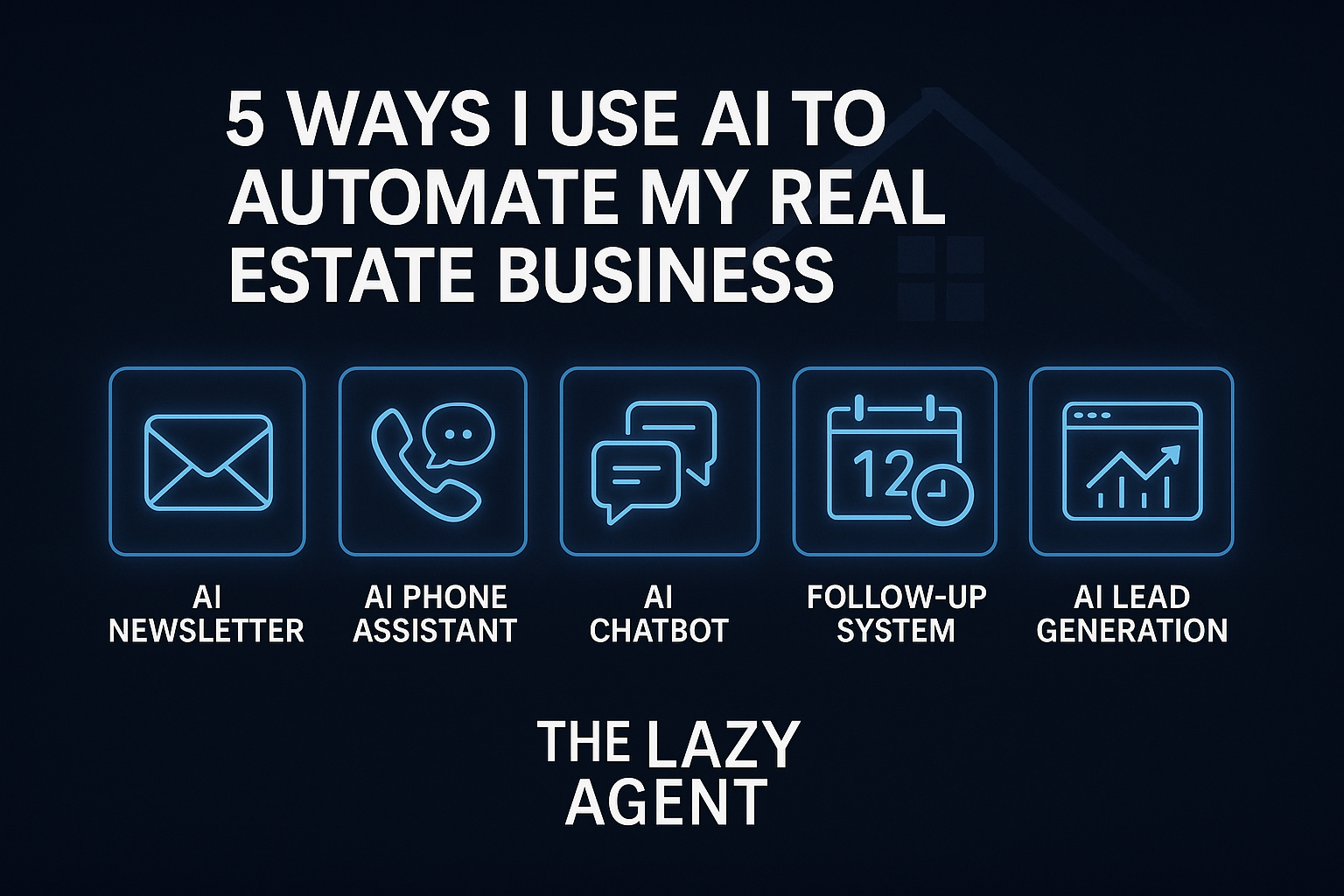
AI real estate automation is no longer a futuristic concept — it’s the engine behind how top-producing agents are scaling their businesses right now. I personally use AI to automate nearly every part of my real estate business, and the result is over $300,000 a year in commission while working less than 10 hours a week. In this post, I’m breaking down the exact five AI systems I use every day, so you can copy my playbook.
Why AI Real Estate Automation Matters in 2026
The real estate industry has reached a tipping point. Over 87% of brokerages and agents are now using AI tools daily, and agents who refuse to adapt are getting left behind. But here’s the thing most agents get wrong: they use AI as a one-off writing tool instead of building interconnected AI systems that run their entire business on autopilot.
That’s exactly what I’ve done. Every system I’m about to show you lives inside GoHighLevel (or works alongside it), and they all talk to each other. The result is a business that generates leads, nurtures them, follows up, books appointments, and stays top-of-mind — all without me lifting a finger.
1. AI-Powered Newsletter That Actually Closes Deals
The first AI system in my real estate automation stack is a fully automated AI newsletter built inside GoHighLevel. This isn’t your typical templated drip campaign — it’s an AI that researches your local market every week and writes a personalized, high-converting newsletter on your behalf.
I ran a nine-month test with 3,000 leads who received nothing but this AI newsletter. No calls, no texts, no other touchpoints. The result? Three closings. That’s the industry benchmark of one to two deals per thousand leads per year — achieved completely hands-free.
How it works under the hood:
The system uses a custom field inside GoHighLevel contacts called “AI Marketing” with toggle switches for newsletter preferences. You can set each contact to newsletter off, email only, or email with SMS backup (a condensed version sent via text if they don’t have an email address).
Every Tuesday at 6:00 AM, a GoHighLevel automation triggers an AI agent that searches the internet for local housing market data in your area. That research feeds into a second AI — the newsletter composer — which writes the email following strict newsletter best practices. A third AI then generates ten subject lines optimized for open rates, and the system automatically picks the best one.
The best part? Everything is self-contained within GoHighLevel’s AI Agent Studio. No Zapier, no external OpenAI integrations, no duct-taped tech stack. It’s all in one platform.
2. AI Phone Assistant via Claude Code + iMessage
The second AI real estate automation I use is something most agents have never seen before. I connected Claude Code (Anthropic’s AI coding assistant) directly to my iPhone via iMessage, and then linked it to GoHighLevel.
This means I can text my AI assistant from my phone and it interacts with my entire CRM. Need to look up a lead? Text it. Want to add notes to a contact? Text it. Need to check your calendar? Text it. It’s like having a virtual assistant in your pocket that has full access to your business systems, available 24/7.
3. Conversational AI Chatbot & Voice AI That Books Appointments
The third way I use AI real estate automation is through a conversational AI system built into GoHighLevel that handles both text-based chat and live phone calls.
On the chatbot side, the AI answers questions from website visitors, qualifies leads, and books appointments directly into my calendar. But the real showstopper is the voice AI component.
Here’s a real example of what the voice AI can do:
A caller asks about a property at 290 Prince Avenue in Bellingham listed at $825,000. The AI pulls real-time listing data from Zillow via a custom API integration, answers questions about bedrooms, bathrooms, square footage, HOA fees, and days on market — then books a showing appointment for the next morning. The appointment shows up in the GoHighLevel calendar automatically.
4. AI Follow-Up System That Nurtures Leads Like a Human
The fourth AI real estate automation strategy is the one I’m most proud of — and it’s the one I haven’t seen anyone else do well. Most AI follow-up systems are glorified drip campaigns with a ChatGPT wrapper. Mine is fundamentally different.
This AI reads conversation history, reviews notes, understands pipeline stages, and writes completely custom follow-up messages that feel like they came from a real person. It even knows when to follow up based on context.
Here’s a real-world example: A lead mentioned they couldn’t talk because they were coaching their kid’s T-ball game. The AI scheduled a follow-up for the next day with a message referencing the T-ball game before transitioning into a soft check-in about their home search. That level of personalization is something most human agents don’t even do consistently.
The system uses eight separate GoHighLevel automations working together to manage the entire follow-up lifecycle. Here’s how the pipeline stages work:
The AI automatically categorizes leads as cold, warm, or hot based on their responses. A lead that says “we’re looking to buy soon” gets tagged as hot with more aggressive follow-up. A lead that mentions their lease doesn’t expire for 12 months gets categorized as cold with a longer nurture cadence. The AI rotates between SMS, voicemail drops, and email so the touchpoints feel varied and natural.
5. AI-Powered Lead Generation Through SEO & GEO
The fifth and final way I use AI real estate automation is for lead generation itself. All the follow-up and nurturing systems in the world don’t matter without a steady flow of new leads, and this is where most agents struggle to automate.
My approach uses AI to build and maintain entire websites that generate organic traffic through both traditional SEO (search engine optimization) and GEO (generative engine optimization — ranking in AI-powered search tools like ChatGPT, Perplexity, Gemini, and Claude).
I have two AI-powered websites running right now. The first is thelazyagent.com, which has generated over 5,000 organic leads with zero paid advertising. The second is a new hyper-local site for my market area that I’m building using the same playbook.
The three-layer AI content system:
The entire operation runs on three scheduled AI tasks that keep the website growing and optimized without any manual intervention:
Daily content AI (7:00 AM every day): An agentic AI writes and publishes a fully optimized blog post following a detailed content strategy, complete with internal links, FAQ schema, CTAs, and SEO best practices. After publishing, it performs a full self-audit — logging into WordPress to verify meta descriptions, keyword placement, and technical SEO elements. The entire process takes 10–20 minutes.
Weekly SEO audit (Sundays at 9:00 AM): A separate AI reviews every post published that week and triple-checks for errors, broken links, missing metadata, FAQ schema issues, and CTA placement. If it detects the daily content AI is drifting from best practices, it updates the daily AI’s instructions.
Monthly deep-dive audit: This AI performs competitor research, updates the keyword strategy, evaluates traffic patterns, and adjusts the overall content calendar. It keeps the daily and weekly AIs aligned with what’s actually working.
This self-healing website architecture means the content isn’t just AI-generated — it’s AI-maintained. The weekly audit catches problems the daily AI might miss, and the monthly audit adjusts the strategy based on real performance data. It’s a level of content quality control that would require a full-time content manager to replicate manually.
Want to Automate Your Entire Business?
Frequently Asked Questions

