Table of Contents
- The Hook: Why This Matters Right Now
- What Are AI Voice Agents? (Not What You Think)
- Shame on Me: My $50K Mistake with ISAs
- The Real Math: ISA vs. AI Voice Agent
- How This Actually Works (Step by Step)
- Best Platforms for Real Estate in 2026
- What Actually Matters When Choosing
- How to Actually Launch This (Playbook)
- The 5 Mistakes I See Constantly
- Questions You Probably Have
AI Voice Agents Are Replacing Your ISA in 2026
If I wanted to replace a $5,000-a-month ISA without killing my lead response quality, I would immediately set up an AI voice agent.
Here’s the thing: it’s not 2019 anymore. The robocalls and terrible IVR systems that made you cringe five years ago? Gone. In 2026, AI voice agents sound like actual humans, understand real estate terminology, handle objections naturally, and can book appointments on your calendar without touching a keyboard.
The best part? They do it 24/7/365 for a fraction of what you’re paying someone to work 8-10 hours a day.
What Are AI Voice Agents (and No, They Don’t Sound Like Robots)
Let me be crystal clear about what we’re talking about here. AI voice agents are software systems that conduct real phone conversations using actual natural language processing and large language models.
The difference between what we have now versus five years ago is night and day. These agents sound like humans. They understand nuance. They can talk about neighborhoods, financing options, property types, and timelines in a conversation that actually flows — not like they’re reading from a robocall script.
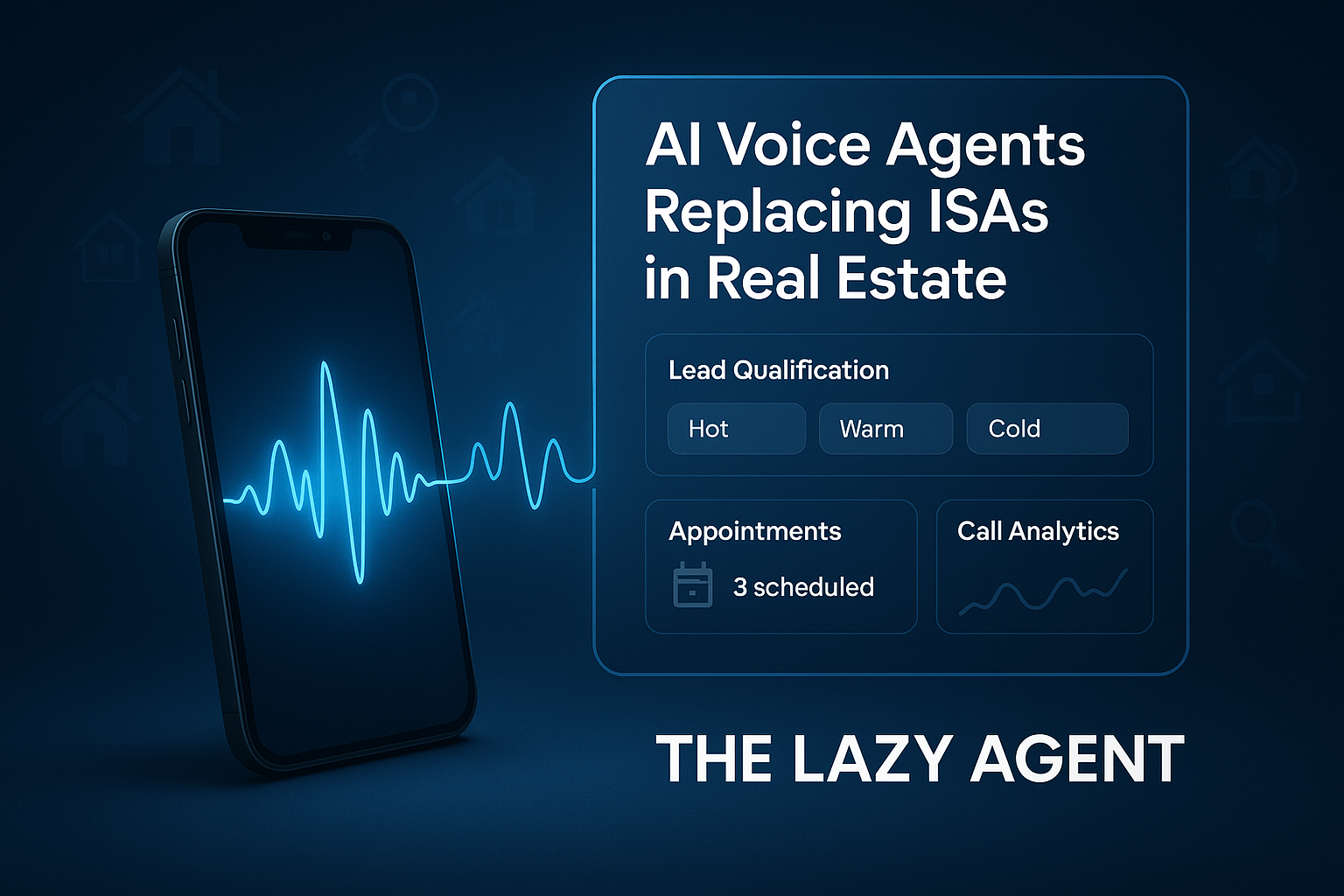
Here’s the process: A new lead comes in from Zillow, your website, Realtor.com, a Facebook ad, whatever. The AI voice agent detects it within seconds. It calls them, introduces itself, asks real qualifying questions (budget, timeline, pre-approval status, neighborhood preferences), answers their questions, and books a showing or consultation directly on your calendar.
Everything — contact info, property interests, qualification status, budget, timeline, the entire conversation notes — flows directly into your CRM without you or anyone else manually typing anything.
Most people focus on cost savings. That’s important, but here’s what actually matters: response time. Studies show responding to a lead within 5 minutes makes you 21x more likely to qualify them. AI responds in under 60 seconds. Every. Single. Time. Your humans are probably getting to them in 2-3 hours (if they’re lucky).
Shame on Me: Here’s What I Got Wrong About ISAs
A few years ago, I had a team of three ISAs costing us about $15,000 a month combined. They were handling maybe 200 leads a month total — with gaps. Someone calls at 6 PM? No answer. Someone calls on Sunday? No answer. One person gets sick? The phones go dead.
And here’s the part that really bothers me when I think about it now: we were paying all that money while still missing calls and losing leads we could have qualified.
The moment we moved to an AI voice agent system for initial qualification, everything changed. Suddenly we were handling 8-10x the volume at about 1/5th the cost. The frustrating part? We could have done this three years earlier.
If you’re in that same spot right now — paying for humans to do high-volume, repetitive qualification work — you’re leaving serious money on the table.
Before We Go Further, Let’s Establish the Numbers
I’m not a numbers guy, but I highly, highly recommend doing this math for your specific situation. It’s eye-opening.
Here’s what most teams are working with:
Now do the math for your situation: If you’re handling 500 leads a month, you need 5-10 human ISAs to cover that volume. Cost? $20,000-$60,000 monthly.
One solid AI voice agent system? $1,000-$2,000 a month.
That’s not an incremental improvement. That’s a fundamental shift in your business economics. Which is totally fine if you’re comfortable maintaining status quo. But if you want to scale, this is an absolute gamechanger.
Here’s How This Actually Works (The 6-Step Process)
Before I show you which platforms are worth your money, we need to establish how this works behind the scenes. Understanding this helps you evaluate platforms and set realistic expectations about what’s actually possible.
Step 1: Lead Trigger
A new lead enters your system. Could be Zillow, your website, Facebook ad, a sign call, whatever. The AI voice agent detects the new contact within seconds.
Step 2: Instant Outreach
The agent places an outbound call (or picks up an inbound call). It greets the lead by name, introduces itself, and starts a natural conversation using a script you’ve customized for your market and brand voice. This isn’t a robocall — it’s conversational.
Step 3: Real Qualification
The agent asks questions naturally. Budget range? Check. Purchase or sale timeline? Check. Pre-approval status? Yes. Neighborhood preferences? Yep. Property requirements? Got it. The key difference here is that modern AI can handle follow-up questions, objections, and tangents naturally. If a lead says, “Actually, we just got pre-approved last week,” the agent understands that and adjusts the conversation accordingly.
Step 4: CRM Sync (This is Critical)
Every single piece of data from that conversation automatically populates your CRM. Contact info, qualification status, property interests, detailed notes — all flowing in without anyone manually typing anything. This integrates with GoHighLevel, Follow Up Boss, kvCORE, Sierra, and other major platforms.
Step 5: Appointment Booking
If the lead is qualified and ready, the agent books an appointment directly on your calendar. If they’re not ready yet, the agent schedules a follow-up call or drops them into an automated nurture sequence.
Step 6: The Handoff
You get a notification with a complete summary of the conversation, qualification details, and the scheduled appointment. You walk into that meeting fully prepared. Zero lead chasing on your part.
Pair your AI voice agent with a solid automation workflow that handles text and email follow-up too. The voice agent qualifies, and your drip campaigns keep them warm. This combo is an absolute gamechanger.
Which Platforms Are Actually Worth It in 2026
Not all AI voice agents are created equal. Here are the ones I’m seeing produce real results for real estate teams:
Structurely — Built specifically for real estate. Their voice agents handle full qualifying conversations and write structured results directly into your CRM. Best for teams that have outgrown manual lead screening. Pricing: $500-$1,200/month depending on volume.
Ylopo AI (rAIya) — If you’re already using Ylopo for lead generation, rAIya is a natural extension. Combines AI voice and text follow-up with their lead gen platform for a seamless pipeline. Particularly strong if you’re running heavy PPC campaigns.
CloudTalk — Cloud-based voice automation with powerful AI calling. Their CeTe AI agent handles inbound and outbound engagement in multiple languages. Best for teams that want deep telephony features alongside AI.
Callers AI — Goes beyond voice with omnichannel automation across calls, SMS, WhatsApp, and web chat. Good choice if you want a single platform handling all communication channels.
SquadStack AI — Hybrid approach combining AI automation with human sales agents. AI handles initial outreach and qualification, then escalates promising conversations to humans when needed. Good for teams that want a safety net during the transition from human ISAs.
The cheapest option with poor voice quality or slow response times will cost you more in lost leads than the premium platform would have cost in subscription fees. Always test with real leads before committing. I know a lot of you think “I’ll just go with the cheapest option” — which is totally fine. But run the math on lost leads first.
What Actually Matters When You’re Evaluating This
Five non-negotiable features separate the tools that actually work from the ones that waste your money:
Sub-500ms Response Latency
Natural conversation requires near-instant responses. If there’s a noticeable delay after the lead speaks, it feels robotic and people hang up. Best platforms achieve response times under half a second. This is non-negotiable.
Deep CRM Integration
You need real-time read and write access to your CRM — not just a one-way data dump. The agent should pull existing contact history and push new data simultaneously. Make sure it integrates with your specific system, whether that’s GoHighLevel, Follow Up Boss, kvCORE, or another platform. Don’t assume.
Customizable Conversation Flows
Your market is different from every other market. You need to customize the qualifying questions, the tone, the objection handling, and the local knowledge your agent uses. Cookie-cutter scripts are a disaster.
Multi-Language Support
In 2026, the best agents support 10-20+ languages including Spanish, Mandarin, Vietnamese, and Portuguese. If you serve a diverse market, this is critical.
Detailed Call Analytics
You should be able to see call duration, qualification rates, appointment booking rates, and conversation transcripts. Without data, you can’t optimize anything.
Here’s How to Actually Launch This (The Playbook)
Getting started is less complicated than you think. Most platforms can be fully operational within 1-2 weeks. Here’s exactly what that looks like:
Week 1: Foundation
Choose your platform. Connect your CRM. Set up your phone numbers. Customize your conversation scripts for your market and brand voice. Start with your most common lead scenarios — buyer inquiries from portal sites and seller valuation requests. Be super clear about your qualifying criteria: What makes a lead “hot” for you? Define that before you launch.
Week 2: Testing and Launch
Run test calls with your team. Have actual agents call in pretending to be different types of leads — first-time buyers, investors, tire-kickers, motivated sellers. Listen to the recordings. Refine your scripts based on where the conversations break down. Don’t skip this step.
Ongoing: Optimization
Review call analytics weekly. Look for patterns in where leads drop off, what questions the AI struggles with, which lead sources produce the best conversations. Adjust your scripts and qualification criteria accordingly. This is where most people fail — they set it up and forget it. Don’t do that.
Start with your highest-volume, lowest-complexity lead source first. Portal leads (Zillow, Realtor.com) are ideal — they ask predictable questions and follow common patterns. Once you’ve dialed in the AI for those, expand to other lead sources. This prevents you from burning out on training.
The 5 Mistakes I See Constantly
After watching hundreds of agents implement AI voice systems, these are the patterns that trip people up:
1. Not Customizing the Scripts
The default templates work, but they don’t represent your brand or your market. Spend the time to customize your qualifying questions, local knowledge, and objection handling. A generic AI is better than no AI. A customized AI is exponentially better than generic.
2. Setting It and Forgetting It
AI voice agents need ongoing optimization just like any other part of your automation workflow. Review call analytics at least weekly and refine scripts based on real conversation data. This is the difference between good implementation and great implementation.
3. Using AI for Everything
AI voice agents are incredible for initial qualification and follow-up. They’re not great for handling emotional conversations, negotiating complex situations, or building deep personal relationships. Know when to hand off to a human. That’s actually smart.
4. Ignoring the Handoff Experience
The moment when a qualified lead transitions from the AI to you is critical. If you don’t call them back promptly after the AI books the appointment, you lose all the goodwill the AI built. Set up notifications and commit to fast human follow-up on hot leads. This is where most teams leak leads.
5. Not Integrating With Your Full Tech Stack
An AI voice agent that doesn’t talk to your CRM, your calendar, your post-close automation system, and your nurture campaigns is leaving serious value on the table. The power is in the integration, not the standalone tool.
If you’re already using AI tools across your real estate business, adding a voice agent is the natural next step. It fills the biggest gap most agents have — the phone — and makes your entire automation ecosystem exponentially more powerful.
Ready to Automate Your Entire Lead Pipeline?
Join hundreds of real estate agents automating their entire business. Learn the systems that are generating qualified leads 24/7.
Ready to Automate Your Entire Lead Pipeline?
Join hundreds of real estate agents automating their entire business. Learn the systems that are generating qualified leads 24/7.
Questions You’re Probably Having Right Now
For initial lead qualification and appointment booking, yes. AI voice agents handle high-volume, repetitive conversations more consistently and at a fraction of the cost. Most teams keep one senior human ISA for complex situations while letting AI handle 80-90% of initial contacts. The hybrid approach is highly, highly recommended.
Most platforms charge between $500 and $1,500 per month depending on call volume and features. Some offer pay-as-you-go pricing starting around $0.07 per minute. Compare this to $3,500-$6,000+ for a human ISA and the ROI is obvious. The math practically does itself.
It depends on the platform and your local regulations. Most modern AI voice agents sound natural enough that leads may not immediately realize it’s AI. However, many states require disclosure. Check your local laws and err on the side of transparency. Most leads don’t mind AI if it’s helpful and responsive.
Most platforms integrate with Follow Up Boss, kvCORE, GoHighLevel, Sierra, Salesforce, HubSpot, and other major real estate CRMs. Always verify your specific CRM is supported before committing to a platform. Don’t assume — ask directly.
Most platforms can be fully operational within one to two weeks, including conversation script customization, CRM integration, phone number setup, and testing. The initial setup is straightforward. The ongoing optimization is where the real work happens.
Yes. Most platforms support both. They can answer incoming calls from sign riders, website inquiries, or portal leads, and also make outbound calls to new leads, follow-up contacts, and re-engagement campaigns.
Your Next Move
The only question left is whether you’re going to take action. If you’re spending $4,000-$6,000 a month on an ISA right now, the math is forcing you to make a decision.